
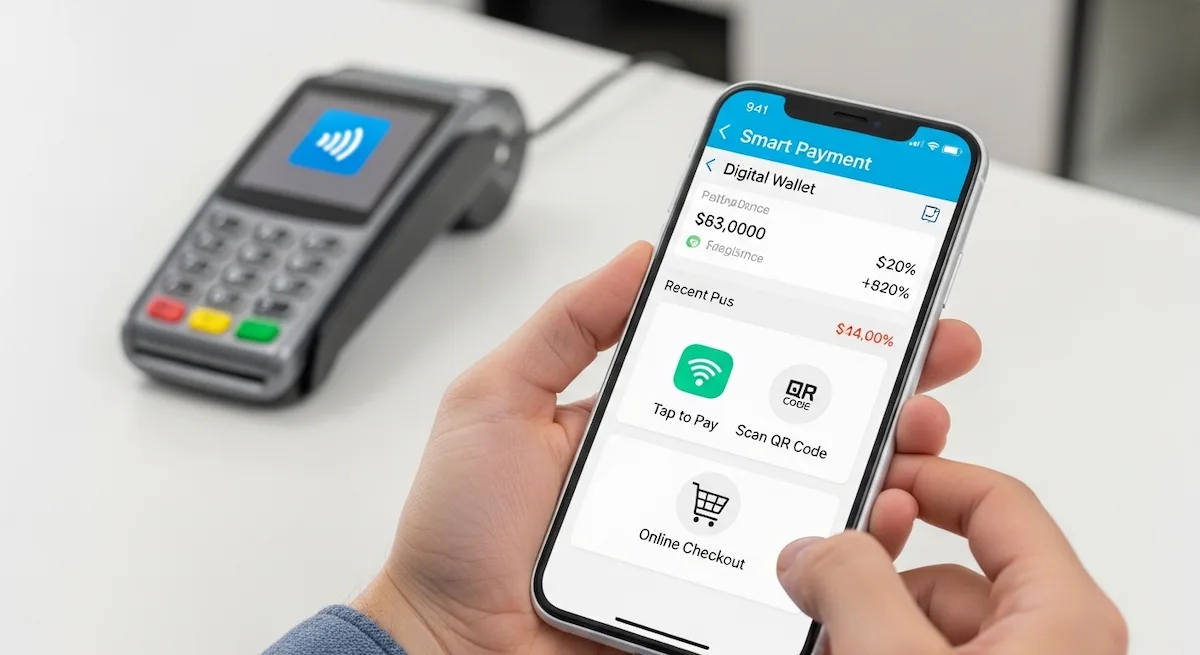

Explore the surge in smart payment methods, from contactless cards to mobile wallets, and how they’re revolutionizing convenience and security in today’s digital world. Discover the future of payments!
Introduction
Remember fumbling for cash or digging through a bulky wallet for that one specific card? It feels like a relic of the past, doesn’t it? We’re living in an era where technology isn’t just a convenience; it’s woven into the very fabric of our daily lives, and that includes how we pay for things. The way we conduct transactions has undergone a seismic shift, and at the forefront of this revolution is The Rise of Smart Payment Methods: Convenience and Security. Forget waiting in long queues to swipe your card or worrying about carrying large sums of money. Smart payment methods have burst onto the scene, offering an unparalleled blend of ease and robust protection.
This isn’t just about making payments faster, though that’s certainly a huge plus. It’s about a fundamental change in how we interact with merchants, banks, and even each other, making transactions smoother, more intuitive, and, crucially, safer. Whether you’re grabbing a coffee on your commute, buying groceries for the week, or even sending money to a friend across the globe, smart payment methods are there, streamlining the process. We’re talking about a world where your smartphone or a simple tap of your card can do the heavy lifting, leaving behind the cumbersome traditional methods.
But with all this new tech, a common question pops up: is it really as secure as it claims to be? We’ll delve deep into that, dissecting the incredible security features that underpin these innovative systems and addressing any lingering concerns. Get ready to explore the exciting landscape of smart payments, understand what makes them tick, and see why they’re not just a trend, but the future of how we exchange value. It’s a journey into a world where your wallet might just become obsolete, and your digital life takes center stage.
A New Era of Transactions
Gone are the days when a physical wallet crammed with plastic and paper was the sole gatekeeper of our financial lives. The digital age has ushered in a paradigm shift, and the way we pay for goods and services is at the heart of it. We’ve witnessed a meteoric rise in smart payment methods, and it’s not just a fleeting trend; it’s a fundamental evolution. This transformation is driven by an insatiable demand for convenience and a growing awareness of the need for enhanced security in an increasingly interconnected world.
The Evolution from Plastic to Pixels
For decades, credit and debit cards reigned supreme. They offered a step up from cash, providing a measure of security and the ability to make purchases on credit. However, even plastic had its limitations. The physical act of swiping or inserting a card, entering a PIN, and waiting for authorization could feel like a mini-marathon, especially during peak hours. Moreover, the inherent risk of card skimming and data breaches loomed large, causing many to feel a sense of unease.
Then came the smartphone, a device that quickly transcended its primary function to become an indispensable tool for virtually every aspect of our lives. It was only natural that it would revolutionize payments too. This is where the real excitement of The Rise of Smart Payment Methods: Convenience and Security truly begins to unfold.
What Exactly Are Smart Payment Methods?
Simply put, smart payment methods leverage technology to facilitate transactions, often eliminating the need for physical cards or cash. They can encompass a broad range of technologies and platforms, but generally, they fall into a few key categories:
- Contactless Payments: This is perhaps the most ubiquitous form of smart payment today. Think of those cards with a little Wi-Fi-like symbol on them. A simple tap near a compatible terminal is all it takes to complete a transaction, typically for smaller amounts. This technology has become incredibly widespread, making quick purchases a breeze.
- Mobile Wallets: Platforms like Apple Pay, Google Pay, and Samsung Pay allow you to store digital versions of your credit and debit cards on your smartphone or smartwatch. You can then use your device to make payments at compatible terminals. It’s like having your entire wallet in your pocket, securely stored on your phone.
- QR Code Payments: While more prevalent in certain regions, QR code payments are gaining traction globally. A merchant displays a QR code, which you scan with your phone’s camera. This can either initiate a payment directly from your app or display payment details for you to confirm. It’s particularly useful for peer-to-peer transactions and in markets where mobile penetration is high but advanced POS systems are less common.
- Wearable Technology: Beyond smartwatches, we’re seeing payment capabilities integrated into rings, bracelets, and even clothing. These devices offer an even more seamless and discreet way to pay, often requiring just a simple gesture.
- Online Payment Gateways and Services: While not always considered “smart” in the same vein as contactless, services like PayPal, Venmo, and Square have fundamentally changed online and peer-to-peer payments, offering ease of use and security features that were previously unavailable.
The Unbeatable Appeal: Convenience
Let’s be honest, the primary driver behind the adoption of smart payment methods is the sheer convenience they offer. It’s about simplifying our lives and cutting down on friction points.
Speed and Efficiency at Your Fingertips
Imagine this: you’re in a rush, a long queue has formed at the coffee shop, and you just need that caffeine fix. With a smart payment method, it’s a matter of seconds. A quick tap of your phone or card, and you’re done. No fumbling for change, no waiting for the chip reader to finish its cycle, no signing receipts. This speed translates to a better customer experience for shoppers and more efficient operations for businesses. For retailers, faster checkout lines mean more customers served, fewer lost sales due to impatience, and a generally more positive retail environment.
Decluttering Your Pockets (and Your Mind)
How many cards do you actually carry in your wallet? Three? Five? Ten? For many, it’s a collection of bank cards, loyalty cards, and maybe even a library card or two. Mobile wallets offer the tantalizing prospect of consolidating all of these into a single device that you’re probably already carrying everywhere. Not only does this lighten your physical load, but it also reduces the mental overhead of keeping track of multiple pieces of plastic. Losing your wallet used to be a nightmare of cancelled cards and identity theft worries. Now, losing your phone, while still inconvenient, often means your payment methods are still protected by biometrics or passcodes.
Seamless Online and In-App Purchases
Beyond physical stores, smart payment methods have revolutionized online shopping. Pre-saved payment details and one-click checkout options, powered by secure payment gateways, have made online purchases as simple as a few clicks. In-app purchases, whether for games, subscriptions, or digital content, are similarly streamlined. This frictionless experience encourages impulse buys and makes it incredibly easy to access digital services.
Peer-to-Peer Payments Made Easy
Remember awkward moments trying to split a bill or pay back a friend? Services like Venmo, Zelle, and Cash App have made peer-to-peer (P2P) payments incredibly simple. A few taps within an app, and the money is transferred, often instantly. This has eliminated the need for IOUs and the hassle of exchanging cash, especially for small amounts between friends and family.
The Unwavering Shield: Security
While convenience is a major draw, the question of security is paramount. Thankfully, smart payment methods often incorporate advanced security features that can, in many cases, be superior to traditional card payments.
The Power of Tokenization
One of the cornerstone security features of many smart payment systems, particularly mobile wallets, is tokenization. Instead of your actual card number being transmitted during a transaction, a unique, randomly generated code called a token is used. This token is specific to your device and merchant. If a hacker were to intercept this token, it would be useless for making other purchases because it cannot be linked back to your original card details. This significantly reduces the risk of your sensitive financial information being compromised.
Biometric Authentication: Your Fingerprint, Your Face
Remember signing receipts? That was a weak form of authentication. Smart payment methods leverage much stronger methods. Your smartphone likely uses fingerprint scanning (Touch ID) or facial recognition (Face ID) to authorize payments. These biometric identifiers are unique to you and are far more secure than a signature or even a PIN, which can be observed or guessed. This ensures that only you can authorize a transaction, even if someone else gets hold of your device.
Encryption: The Digital Locksmith
From the moment your payment information leaves your device to when it reaches the payment processor, it is heavily encrypted. This means the data is scrambled into an unreadable format, accessible only by authorized parties with the correct decryption key. This layered approach to encryption protects your data at every stage of the transaction, making it incredibly difficult for malicious actors to intercept and decipher.
Fraud Monitoring and Real-Time Alerts
Financial institutions and payment providers employ sophisticated fraud detection systems that continuously monitor transactions for suspicious activity. They use algorithms and AI to identify patterns that might indicate fraud. Furthermore, many smart payment apps provide real-time notifications for every transaction, allowing you to immediately spot and report any unauthorized activity. This proactive approach to fraud prevention is a significant advantage.
The Decline of the Magnetic Stripe
The older magnetic stripe on the back of credit and debit cards is notoriously insecure and susceptible to skimming. Contactless cards and mobile wallets, which utilize more advanced chip technology and tokenization, largely bypass the need to use the magnetic stripe, thus mitigating a significant security vulnerability.
Addressing Common Concerns and FAQs
Even with the robust security measures in place, some users still have questions. Let’s tackle some of the most common ones.
FAQ 1: Is it safe to store my credit card information on my phone?
Absolutely! As mentioned, mobile wallets use tokenization and strong encryption. Your actual card details aren’t stored on your device in a way that’s easily accessible. Furthermore, your phone is protected by your device’s security features (passcode, fingerprint, facial recognition), adding an extra layer of protection that you don’t always have with a physical card.
FAQ 2: What happens if I lose my phone?
While losing your phone is a cause for concern, your payment information is still largely protected. You can usually remotely lock or wipe your device using cloud services, and the payment apps themselves are protected by your device’s security. You can also typically remove your payment cards from your mobile wallet remotely through your bank or the payment provider’s app. It’s a good practice to know how to do this before you face such a situation.
FAQ 3: Are contactless payments vulnerable to “skimming” from a distance?
The concern about “skimming” from a distance is often exaggerated for contactless payments. While theoretically possible, the range for contactless card readers is very short, typically only a few centimeters. For a criminal to skim your card, they would need to be extremely close to you, often within arm’s reach, and the NFC (Near Field Communication) technology used is designed with security protocols to prevent unauthorized data extraction. It’s far less of a risk than many people imagine.
FAQ 4: Do I need a special app or device to use smart payments?
For contactless payments, you generally just need a contactless-enabled card or a smartphone/smartwatch with NFC capabilities and a compatible mobile wallet app installed (like Apple Pay, Google Pay, etc.). For QR code payments, you’ll need the specific app associated with that payment system. The good news is that more and more retailers are equipping their terminals with contactless readers, making it increasingly accessible.
FAQ 5: Are there transaction limits on smart payments?
Transaction limits can vary depending on the payment method, the card issuer, and the merchant. Contactless payments often have lower limits for single transactions for security reasons (e.g., $50 or $100), but you can often make multiple transactions or use a PIN for larger amounts. Mobile wallets and other forms of smart payments often have higher or no specific limits beyond those set by your bank or credit card company.
The Future is Smart, The Future is Now
The transition from traditional payment methods to smart payment systems is not merely a technological upgrade; it’s a fundamental reshaping of our financial interactions. The Rise of Smart Payment Methods: Convenience and Security is a narrative of innovation meeting user demand, creating a more efficient, secure, and ultimately, a more integrated way to manage our money.
We’ve seen how contactless technology, mobile wallets, and other smart solutions have drastically simplified the checkout process, decluttered our lives, and made peer-to-peer transactions a breeze. All this convenience, however, is underpinned by sophisticated security measures like tokenization, biometric authentication, and robust encryption, which offer a powerful shield against fraud. While concerns are natural with any new technology, the security protocols in place are designed to be more robust than many older, traditional methods.
As technology continues to advance at breakneck speed, we can expect even more innovative payment solutions to emerge. Perhaps we’ll see payments integrated more seamlessly into augmented reality experiences, or even more discreet wearable payment devices. One thing is for certain: the trend towards smarter, more convenient, and more secure payment methods is irreversible. Embracing these changes not only simplifies our daily financial lives but also positions us at the forefront of a global digital transformation. So, the next time you tap your phone to pay for your latte, take a moment to appreciate the sophisticated technology and security that made it all possible. The future of payments is here, and it’s incredibly smart.
Disclaimer: This article is for informational and educational purposes only and should not be construed as financial, investment, or legal advice. Financial markets and product terms change frequently. Always conduct your own research or consult with a qualified financial advisor before making any financial decisions.