
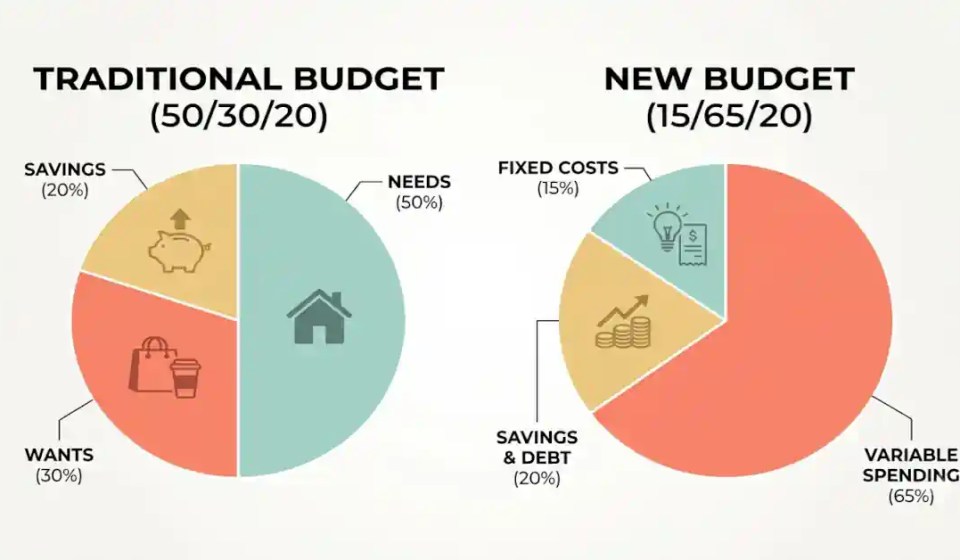

For years, financial advice boiled down to three simple numbers: 50/30/20. The concept was straightforward. You put 50% of your income toward needs, 30% toward wants, and 20% toward savings. It was a golden rule for managing personal finances. However, recent economic shifts have made this framework difficult for many people to follow. Rising rent, utility costs, and grocery prices are squeezing the budget. As a result, many people are now shifting to a new model. The 15/65/20 budget is becoming a necessary way to adapt to modern reality. This adjustment does not mean abandoning good money habits. Instead, it offers a more honest look at the cost of living today.
Deconstructing the Classic 50/30/20 Framework
The classic model worked well when essential costs were lower. It provided a comfortable buffer. Today, that buffer is disappearing.
The Necessity Bracket: Why 50% for Needs is No Longer Sufficient
“Needs” include housing, food, transportation, and minimum debt payments. These expenses are essential for daily survival. In many parts of the country, housing costs alone now consume nearly half of a typical paycheck. When you add electricity, water, internet, and groceries, the 50% limit is often breached immediately. Inflation has made these costs less flexible than in the past. You cannot easily negotiate a lower rent or utility bill. For many, capping these essential costs at 50% is no longer a realistic goal. They are consistently spending 60% or more just to keep a roof over their heads.
The Want vs. Necessity Blur: Where Discretionary Spending Creeps In
The line between “needs” and “wants” has become fuzzy. Consider the role of technology. Reliable internet and a smartphone are now required for most jobs. These items might have been categorized as discretionary spending in previous years. Now, they are essential tools for earning income. This blurring makes it harder to fit expenses into the old 30% “wants” category. Lifestyle creep also plays a role. It is easy to label subscription services or dining out as “wants” while slowly increasing how much you spend on them. Without strict boundaries, these items push your discretionary spending well beyond the original budget limit.
The Savings Slowdown: Assessing the Impact of Low Savings Rates
When essentials balloon beyond 50%, something has to give. Often, that “something” is the 20% allocated to savings and debt repayment. If you are forced to spend 65% on essentials and still want some “wants,” your savings will take a hit. This leads to inadequate emergency funds and delayed retirement planning. The danger here is long-term. You might manage your daily cash flow, but you sacrifice your future security. The 50/30/20 rule assumes a level of stability that many earners currently lack.
Understanding the 15/65/20 Budget Philosophy
The 15/65/20 budget is an honest adaptation to current economic conditions. It acknowledges that essential costs have risen. By realigning the categories, it provides a clearer picture of your financial life.
Decoding the 65% Allocation: A Realistic Look at Modern Living Expenses
The new “Needs” category, set at 65%, reflects the reality of high costs for housing and utilities. For many, this adjustment is not a choice but a requirement. If your rent or mortgage eats up a large portion of your monthly income, this higher cap helps you track your reality without feeling like you are failing. It removes the stress of trying to fit an impossible number into a rigid 50% box. This change gives you an accurate baseline for your true essential spending.
The Sacrifice: Why Only 15% is Allocated to Wants
This is the hardest part of the shift. If you increase your needs category to 65%, you must reduce your discretionary spending. The 15/65/20 budget demands that you cut your “wants” in half, from 30% down to 15%. This means you must become much more selective about where your money goes. You will likely spend less on dining out, entertainment, and non-essential shopping. This is a sacrifice, but it is a conscious one. It allows you to fund your necessities and savings without accumulating debt.
The Protected 20%: Maintaining Financial Momentum
The 20% dedicated to savings, investments, and debt payoff must remain untouchable. This is the core of the 15/65/20 rule. Even when costs rise, you must protect your future. By keeping this percentage firm, you ensure that you are still making progress. You might be spending more on rent, and you might have less for fun, but your investments continue to grow. This discipline is what differentiates a sustainable budget from one that just helps you survive the month.
Who Benefits Most from the 15/65/20 Shift?
This adjusted framework is especially useful for specific groups.
Navigating High Cost of Living Areas (HCOL) and Rent Burden
If you live in a major city, housing costs likely eat a massive portion of your income. For many, rent alone hits 40% or more of gross pay. In these situations, keeping total needs under 50% is almost impossible. The 15/65/20 model provides a framework that matches their environment. It helps them avoid the constant frustration of being “over budget” on needs every single month.
Income Level Adaptation: The Struggle for Lower and Middle Incomes
For people with lower or middle incomes, fixed costs like groceries and transport take up a larger percentage of their earnings. The 50/30/20 model is often designed for those with more disposable income. When your income is lower, your essentials are a larger share of your budget by default. This shift lets them manage their money without constantly feeling like they are doing something wrong. It is a more accurate tool for their actual financial life.
Young Professionals and High Student Debt Loads
Young professionals often face two major pressures: high rent and mandatory student loan payments. These debt payments often fall under “needs” because they are not optional. When these payments are high, they consume a large share of the budget. This forces discretionary spending to drop significantly. The 15/65/20 structure provides a clear path forward for those dealing with this specific type of financial pressure.
Practical Application and Making the 15/65/20 Work
A budget is only useful if you use it correctly. Here is how to apply this approach.
Auditing Your “New Needs”: Identifying True Essential Spending
You need to audit your 65% category to keep it from growing further. This means looking at every essential expense. Can you negotiate your internet bill? Are there cheaper grocery stores or meal-planning strategies you can use? By shaving even 2% or 3% off your essential costs, you give yourself a bit more breathing room for the “wants” or savings. Every dollar saved in this category is a victory.
Intentional Austerity: Mastering the 15% Wants
When your “wants” budget is smaller, every purchase needs to matter. Focus on value-based spending. Instead of frequent, small, unmemorable purchases, save that 15% for activities you truly enjoy. Look for free entertainment options, host potlucks instead of eating out, or prioritize one quality trip instead of many small outings. This approach turns a restriction into a deliberate choice.
Automating the 20%: Ensuring Non-Negotiable Progress
The best way to ensure the 20% is saved is to move it before you see it. Set up an automatic transfer to your savings or investment account the same day you get paid. If the money stays in your primary checking account, it is too easy to spend it on “needs” or “wants.” Automation makes saving a habit rather than an afterthought.
Conclusion
The 15/65/20 budget is not a failure of financial planning. It is a smart, flexible adaptation to modern economic pressures. While the classic 50/30/20 model was once the standard, the current reality of rising living costs requires a different approach. By acknowledging the true percentage required for needs, you can maintain control over your spending and keep your financial future secure. The most effective budget is the one that accurately reflects your income and expenses while still protecting your long-term goals. Focus on the 20% savings target, manage your needs intentionally, and be selective with your wants. That is how you build lasting stability in an unpredictable economy.
Disclaimer: This article is for informational and educational purposes only and should not be construed as financial, investment, or legal advice. Financial markets and product terms change frequently. Always conduct your own research or consult with a qualified financial advisor before making any financial decisions.