
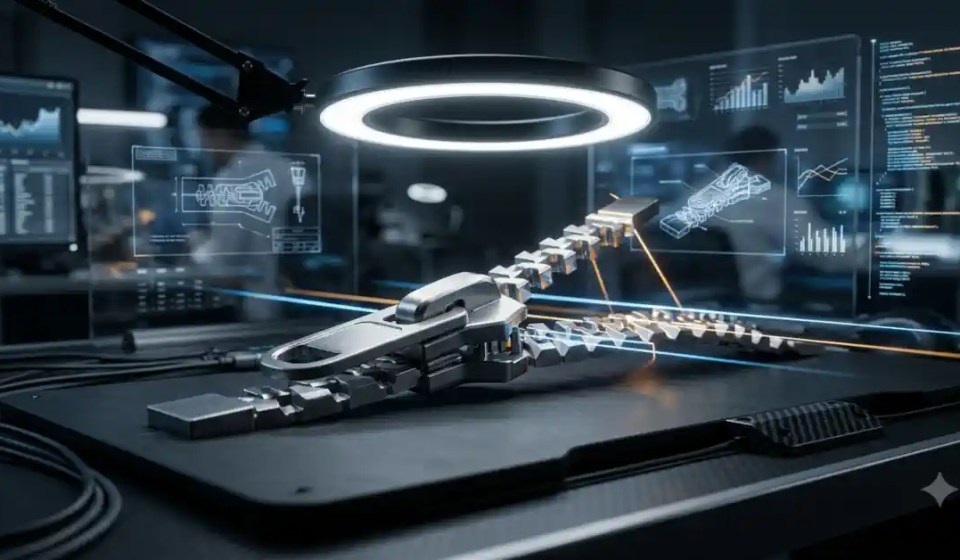

You use a zipper almost every day. It fastens your jacket, secures your luggage, and closes your backpack. Most people never think about the engineering inside those tiny interlocking teeth. We assume the zipper is a finished technology, a simple tool that reached its peak long ago. Yet, a revolutionary zipper design that could change how we build almost anything has spent four decades waiting for the right moment.
The concept was simple, but its execution was nearly impossible in the 1980s. This design is not just a way to close a bag. It is a new way to snap parts together, allowing for rapid assembly of complex structures. For forty years, the idea existed only in sketches and patent papers. It needed the manufacturing power of the 21st century to finally become a reality.
The Genesis of a Design Ahead of Its Time
The Original Inventor and the Market Misunderstanding
In 1985, an MIT professor named William Freeman had a vision for a different kind of fastener. He did not want to just close a seam. He wanted to connect three surfaces at once. The design he created is often called a “Y-zipper” or a triangular zipper.
At the time, the world was not ready. Most manufacturers saw zippers only as a way to join two linear edges of fabric. The idea of a zipper that could handle a junction point—where three sides meet—seemed unnecessary to companies. There was no market demand because no one had ever seen such a thing work. The concept sat in a patent filing, waiting for the industrial world to catch up.
The Core Mechanical Innovation
The difference between this revolutionary zipper design and a standard coil or molded zipper is in the geometry. A standard zipper works on a simple “opposing teeth” principle. It pulls two tracks together along a straight line.
The Y-zipper uses a central hub mechanism. It allows three separate tracks to meet and lock together perfectly. Think of the difference between a simple rope and a complex cable network. The Y-zipper can connect rigid panels, not just flexible fabric. It creates a structural bond, not just a closure. The original theoretical models showed it could carry significant load, which a standard zipper could never do.
Material Limitations of the Analog Era
Forty years ago, the materials available were the biggest blocker. To make this design work, every tooth in the zipper needed to be perfectly shaped. If one tooth was slightly off, the whole junction would jam or break.
The injection molding processes of the mid-1980s were not precise enough. The plastics used were not strong enough to hold the tension at the center hub. Every prototype built back then failed because the physical tolerances were simply too high. You could draw the perfect zipper on paper, but you could not build it with the machines on the factory floor.
The Technological Tipping Point: What Changed?
Advancements in Polymer Science and Injection Molding
The main reason this design works now is that our materials are better. We now have access to high-performance nylons and carbon-filled polymers. These materials are lighter than metal but stronger than the plastics of the past.
Modern high-precision injection molding is the true hero of this story. Machines can now create parts with tolerances measured in microns. This precision ensures that the interlocking teeth of the Y-zipper slide into the central hub without friction. The mechanical components can now be mass-produced with almost zero error. This was the missing link for forty years.
Digital Prototyping and Simulation (CAD/FEA)
Engineers no longer have to build a prototype to know if it will break. Computer-aided design (CAD) and Finite Element Analysis (FEA) software changed everything. Before making a single physical mold, engineers can simulate millions of opening and closing cycles.
They can see exactly where the stress points are on the Y-zipper. They can adjust the angle of a tooth by a fraction of a degree to make it stronger. This digital testing allows for designs that would have been impossible to perfect through trial and error. The computer allows us to find the breaking point before the zipper is even made.
Supply Chain and Cost Reduction
Even if we could build it in 1985, it would have cost too much. Creating a complex, precision-engineered part requires automated systems that did not exist at scale. Today, automated supply chains drive the cost down. The same technology that makes complex smartphone parts now makes these specialized zippers affordable. They can now compete with the price of traditional, mass-produced fasteners.
Real-World Adoption: Where This Zipper Shines Now
High-Performance Outdoor and Tactical Gear
The most obvious place for this revolutionary zipper design is in extreme environments. Military equipment and aerospace gear need to be assembled quickly. Imagine a military tent or a protective shelter that can be snapped together in seconds.
Standard zippers fail when they are covered in mud or sand, or when the material is pulled from multiple directions. The Y-zipper distributes that tension. If you are in a high-wind situation, the zipper holds because the force is spread across three directions instead of two. It is now finding its way into gear where standard zippers would simply pop apart under pressure.
Medical Devices and Accessibility Innovations
Medical gear often needs to be fast and reliable. Think of a prosthetic sleeve that needs to be fitted quickly and securely to a patient’s limb. A traditional strap system is slow and can be uncomfortable. The Y-zipper offers a cleaner, tighter fit.
It also helps with accessibility. One-handed operation is easier with a track that guides itself into a central hub. It simplifies the act of dressing for people with limited mobility. This is a quiet revolution in how medical devices are designed and worn. When you look at medical garments, check for this type of three-way fastener. It is a sign of high-end, user-focused design.
The Consumer Market Entry and Demand Surge
Premium consumer brands are the next to adopt this tech. High-end luggage companies are testing the Y-zipper for their corner-locking systems. Customers want gear that does not just look high-tech but actually performs better. Early feedback shows that people are willing to pay for a closure that does not jam and provides a more secure seal. The slow, steady introduction of this technology into the mainstream is already underway.
Beyond Durability: The Unforeseen Benefits
Enhanced Security and Tamper Resistance
A standard zipper is easy to pick or force open with a pen. The Y-zipper is much harder to manipulate. Because the locking mechanism is held at a center point, there is no simple line to force. This makes it an ideal choice for high-value containment, such as armored cases or secure briefcases. If a thief cannot find the start of the zipper, they cannot open the bag.
Environmental Impact and Longevity
Sustainability is a major goal for many manufacturers. A fastener that lasts ten times longer than a standard one reduces waste. Most zippers are thrown away because the plastic teeth wear out or the slider breaks. By building a stronger, more precise fastener, we create gear that does not need to be replaced as often. This cuts down on the amount of material that ends up in landfills.
Aesthetic Integration and Design Freedom
The Y-zipper is not just functional; it is a design feature. It allows for flush integration into a product’s surface. Instead of a bulky, linear zipper running across a jacket, a designer can create a seamless junction. It changes the visual profile of a product, making it look cleaner and more modern. It gives designers a new tool to think about how objects are shaped and formed.
Conclusion: The Future Forged in the Past
Innovation is rarely a sudden spark. Most great ideas, like the Y-zipper, are ahead of their time. They sit in the shadows, waiting for the world to catch up. The 40-year gap between the original patent and current production shows that engineering is as much about patience as it is about genius.
The story of this zipper teaches us a few core lessons:
- Good design is limited by the manufacturing tools of its time.
- Modern tech like 3D printing and FEA makes complex, stronger designs possible.
- Reliability is the key to mainstream adoption.
Next time you grab a piece of gear, take a close look at the zippers. You might be seeing the results of a forty-year wait, finally brought to life by the right technology. When you spot a fastener that does more than just zip in a straight line, you are looking at the future of design.
Disclaimer: This article is for informational and educational purposes only. Technology and AI tools evolve rapidly, and software features, pricing, or capabilities may change over time. Always verify current features and terms directly with the service provider before making purchases or implementing software decisions.