
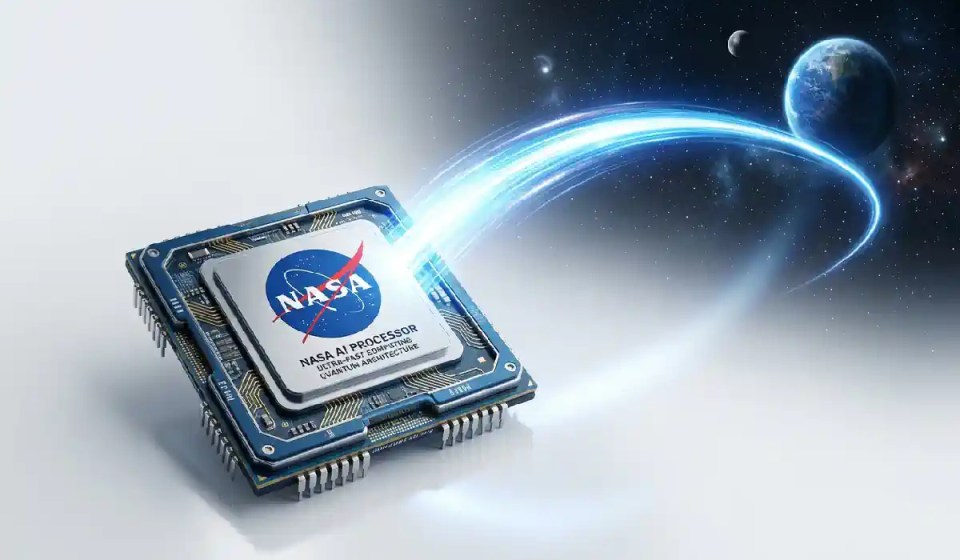

Imagine you are controlling a rover on Mars. You send a command to avoid a dangerous rock. You then wait twenty minutes for the signal to reach the rover. By the time the rover gets the signal, it might have already hit the rock. This long lag time is a constant problem in space missions. It makes remote control risky and slow. NASA’s new AI processor is 500x faster than current space computers. This breakthrough promises to change how we explore space. It will allow spacecraft to think for themselves.
Understanding the Breakthrough: The 500x Faster AI Processor Architecture
Current space electronics have to be tough. They must survive harsh radiation and extreme temperatures. Because of this, computers in space are often decades behind the ones in your smartphone. The RAD750, a common processor used on many missions, is reliable but slow. It cannot handle the heavy processing needed for complex AI tasks. NASA’s new AI processor bridges this gap. It provides a massive jump in capability without losing reliability.
This new chip uses advanced architecture designed for high-speed calculation. While standard computers use a simple, step-by-step approach, this new processor can handle many tasks at once. It uses specialized tensor cores, similar to those in modern AI chips on Earth. These cores are built to run neural networks quickly. This is what allows it to be 500x faster than the older models.
The performance leap is not just a small bump. It is a huge change in how much data a spacecraft can process. In the world of computing, this is measured in how many operations the chip can do per second. For mission planners, this speed means a spacecraft can analyze its surroundings in real-time. It no longer needs to send every bit of data back to Earth for analysis. It can make smart decisions on the fly.
Space is full of high-energy particles. These particles can scramble computer memory and crash systems. This new chip is radiation-hardened from the ground up. Engineers used special materials and design patterns to stop these particles from causing errors. This ensures that the high-speed processing does not stop during a solar storm.
Applications for the 500x Faster AI Processor in Deep Space
Having 500x more computing power changes what a spacecraft can do. It moves the intelligence from Mission Control to the spacecraft itself. This is crucial for navigating tight spaces or reacting to sudden hazards.
When a spacecraft approaches an asteroid, it must be fast. It needs to look at camera images and LIDAR data to avoid crashes. With old processors, this was slow and limited. A craft could only react to simple, planned movements. With this new, faster chip, the craft can track multiple objects at once. It can calculate a new, safe path in a fraction of a second.
Another big problem is data overload. Modern science tools on missions like the James Webb Space Telescope or new Mars rovers produce huge amounts of data. Sending all this data to Earth is slow and expensive. The new processor can act as a filter. It can analyze images and sensor readings right there in space. It can pick out the most important 1% of the data and ignore the rest. This saves huge amounts of bandwidth and time.
Robotic control also sees a big improvement. Think of complex tasks like assembling a lunar base or using a robotic arm to fix a satellite. High latency makes these tasks very hard for human operators on Earth. With a fast processor onboard, the robot can handle fine movements automatically. The human operator gives a high-level command, and the robot figures out the small, quick adjustments needed to get it done.
Impact of the 500x Faster AI Processor on Future Human Missions
Human spaceflight requires the highest level of safety. When astronauts travel to Mars, they will be too far for real-time help from Earth. Their spacecraft must be able to keep them safe on its own.
Autonomous life support monitoring is a key use for this chip. The processor can watch sensors for air pressure, temperature, and power levels every millisecond. If something starts to go wrong, it can spot the problem before it becomes a disaster. It can even suggest or take steps to fix the issue. This level of local intelligence is essential for long-term survival in deep space.
Communication delay is a fixed limit set by the speed of light. Going to Mars, that delay can be up to 22 minutes one way. This makes traditional mission control impossible for urgent needs. The new AI processor bridges this gap by shifting the decision-making process. The spacecraft becomes its own control center. Astronauts can focus on their research while the AI handles the complex system maintenance.
This represents a shift toward decentralized mission control. Instead of every decision coming from Earth, the spacecraft can make many choices alone. This is called edge computing in space. It allows missions to be more flexible and safer. It means the team on the ground can focus on high-level strategy instead of minute-by-minute system checks.
Development Timeline and Adoption Roadmap
Getting a new processor into space is a slow, careful process. NASA does not just build a chip and put it on a rocket. Every piece of hardware must go through strict testing. It faces thermal vacuum chamber tests to simulate space temperatures. It also goes through vibration testing to ensure it can survive the intense launch.
The first step is a prototype. This prototype is used for testing in the lab. Engineers at places like the Jet Propulsion Laboratory or Goddard Space Flight Center verify that the chip acts as expected. Once the design is proven, it moves to flight qualification. This is where the chip is certified for use on an actual space mission.
Target missions are already being identified. Early integration will likely happen on technology demonstration payloads. These missions exist to test new gear in the real environment of space. We may see this processor on Artemis follow-on missions or dedicated deep-space test flights. These flights will prove the hardware works before it is used on a critical human mission.
This technology might not stay only with NASA. Similar advancements are often shared with industry partners like Lockheed Martin or Northrop Grumman. This can lead to better performance for commercial satellites and other private space ventures. If commercial companies can use this speed, it will help the entire space industry move faster.
Conclusion
NASA’s new AI processor is a major jump in space technology. The 500x increase in speed enables missions that were once impossible. It moves us from slow, remote-controlled robots to truly autonomous explorers.
This hardware breakthrough is the foundation for human expansion into the solar system. By allowing spacecraft to think, react, and decide for themselves, we open up the deep space frontier. This change means safer missions, more scientific data, and better control for future astronauts. The dawn of intelligent exploration is here, and it is powered by this new generation of computing.
Disclaimer: This article is for informational and educational purposes only. Technology and AI tools evolve rapidly, and software features, pricing, or capabilities may change over time. Always verify current features and terms directly with the service provider before making purchases or implementing software decisions.



[…] on trending topics like “make $1 million with AI” is how you get eyes on your […]
[…] handheld devices to analyze blood or saliva samples in seconds. A doctor could test a patient for specific toxins or biomarkers during a visit, rather than waiting days for lab results. This speeds up diagnosis […]